Unearthing the
Uncommon
Adaptive admissions interviews that reveal how applicants think, contribute, and fit — surfaced as evidence-based reports for admissions teams.
I noticed your involvement with the tide pool surveys at Cape Point. What specifically got you interested in tracking sea star counts?
So, that first "trend" that felt fake. What did you start noticing about data or information, or even about how people gather it, after that?
The Interview
Interviews that adapt.
Every question is generated in response to what the student just said. No fixed scripts. No predictable prompts. The conversation evolves with the applicant — probing where it matters, moving on where it doesn't.
- Follow-ups reference the applicant's own words
- Depth adapts to the substance of each response
- Tone stays warm, curious, and non-leading
Evidence Linking
Intelligence with integrity.
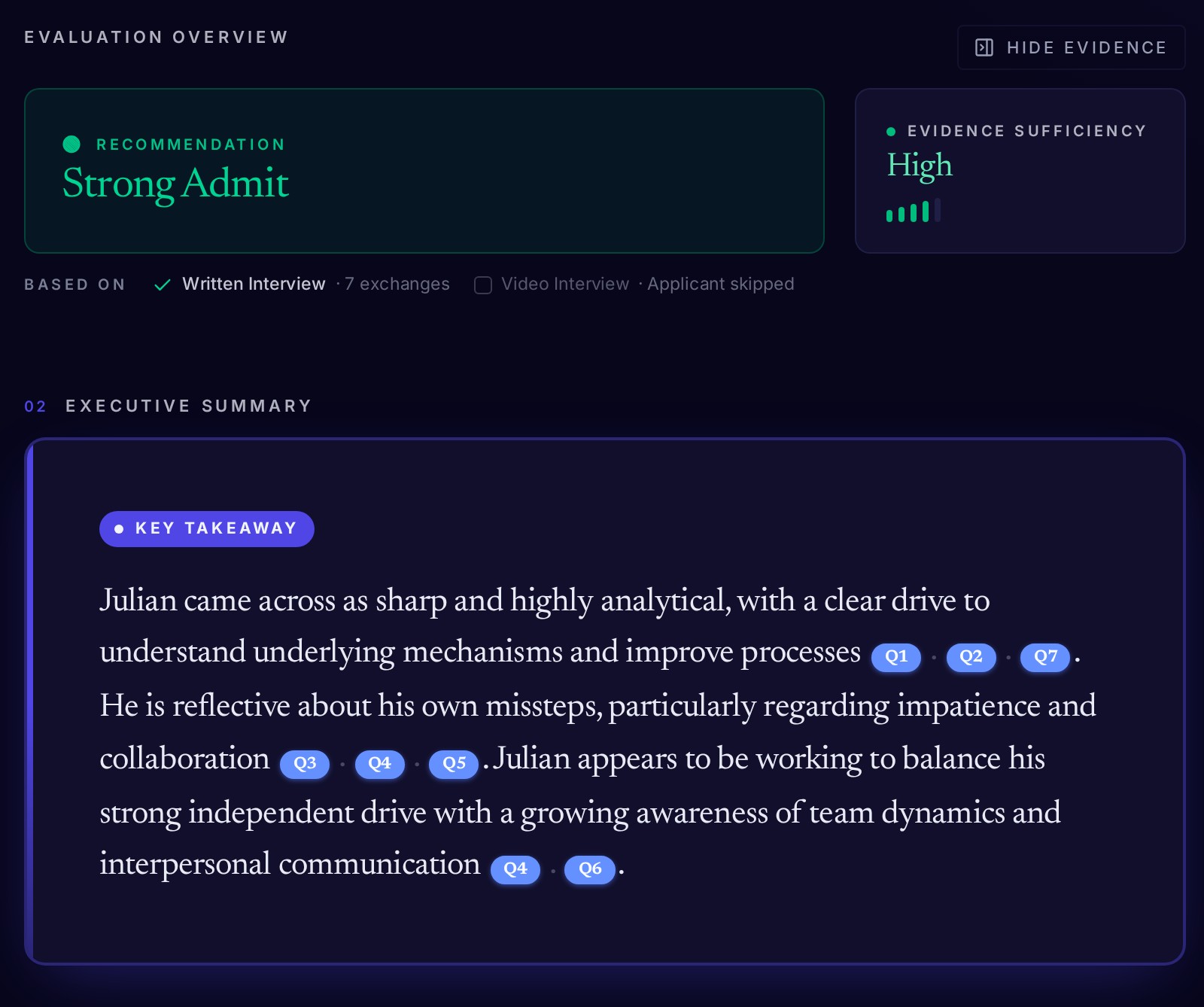
Every insight is anchored to evidence. Aster links every trait evaluation directly to the original interview moment — your team can verify any claim with a single click.
Reflection & Growth
Julian shows significant self-awareness and willingness to re-examine his own assumptions and mistakes. He actively works to change his approach to collaboration and communication.
"I try to ask one question before I argue now. Like with tutoring on Saturdays, one of my fifth graders kept doing long division a strange way and my first instinct was to correct her. Instead I asked her to explain it… Priya told me last month that she brings me ideas earlier now, and I think that's the actual difference."
How It Works
Five steps from roster to committee decision.
Aster fits into the way admissions teams already work. No new interviewers to schedule, no new rubrics to invent.
- 01
Upload applicants
Your team adds applicants — individually or as a CSV roster — and selects the interview template aligned to your institution's values.
Done byAdmissions staffTime< 5 minutes - 02
Applicants complete the interview
Each applicant receives a private link and completes an adaptive, asynchronous video interview on their own time, from a laptop or desktop with a webcam and microphone.
Done byApplicantTimeConfigurable length - 03
Aster analyzes responses
Aster transcribes, structures, and evaluates every exchange against the values you've selected — and links each finding to the moment it occurred.
Done byAutomatedTime2–5 minutes - 04
Reports and evidence are generated
A committee-ready report is produced for each applicant: value alignment, deep analysis, assessment depth, and a recommendation summary — every claim evidence-linked.
Done byAutomatedTimeImmediate - 05
Committee reviews findings
Your committee reads, compares, and decides — with every observation traceable to a specific exchange in the interview transcript.
Done byAdmissions committeeTime3–6 minutes per applicant
For Institutions
Built around your institution.
Every institution defines what matters. Aster adapts its interviews and reports to the values each school chooses to evaluate.
What your admissions team evaluates, and how much each counts.
- Self-Direction
- Intellectual Curiosity
- Initiative & Execution
- Reflection & Growth
- Entrepreneurial Mindset
Each finding maps to a value your school defined.
Reflection & Growth
Julian shows significant self-awareness and willingness to re-examine his own assumptions and mistakes.
- Self-DirectionFinding
- Intellectual CuriosityFinding
Video Analysis
Go beyond the essay.
Aster analyzes video responses alongside written application materials — surfacing strengths, areas worth noting, communication consistency, and thought-development patterns that essays alone can't reveal.
- Analyze interview responses automatically
- Surface strengths and areas worth noting
- Compare spoken and written communication
- Review transcripts and supporting evidence
Designed for Scrutiny
Don't trust a black box. Inspect the evidence.
Aster is built to withstand the questions a committee, a dean, or a procurement office will ask.
Every observation links to the exact transcript moment that supports it. Nothing is asserted without a source.
Your school chooses the values evaluated. Aster reports against your framework, not a generic one.
Aster organizes evidence. Admissions officers make every decision, and can override any observation.
See beyond the application.
Find the uncommon.
Discover how adaptive interviews and evidence-based reports can help your institution understand applicants more deeply.